Showing posts with label Homesteading. Show all posts

11 April 2013

A Day At Heart's Ease Cottage

Well, the weather is warming up and it is time to spend our days outside. I thought I would do a pictorial "Day in the Life" at Heart's Ease Cottage. Just for fun!

We started our morning by making our three day supply of vegetable juice, we buy organic carrots and a few other veggies, but all the greens come from our garden.

After juicing the next job was to clear the bolting lettuce from one of the beds and replant with the starts that just came out from under the lights inside.

Bibb lettuce seedlings go in where the mixed leaf lettuce came out. The romaine in the front of the bed is still tasty so we will try and get it used up before it decides to go bitter and bolt.

My husband took the plastic off the green house tunnels, cleaned them and spread them out to dry so they can be stored until cold weather requires them again.

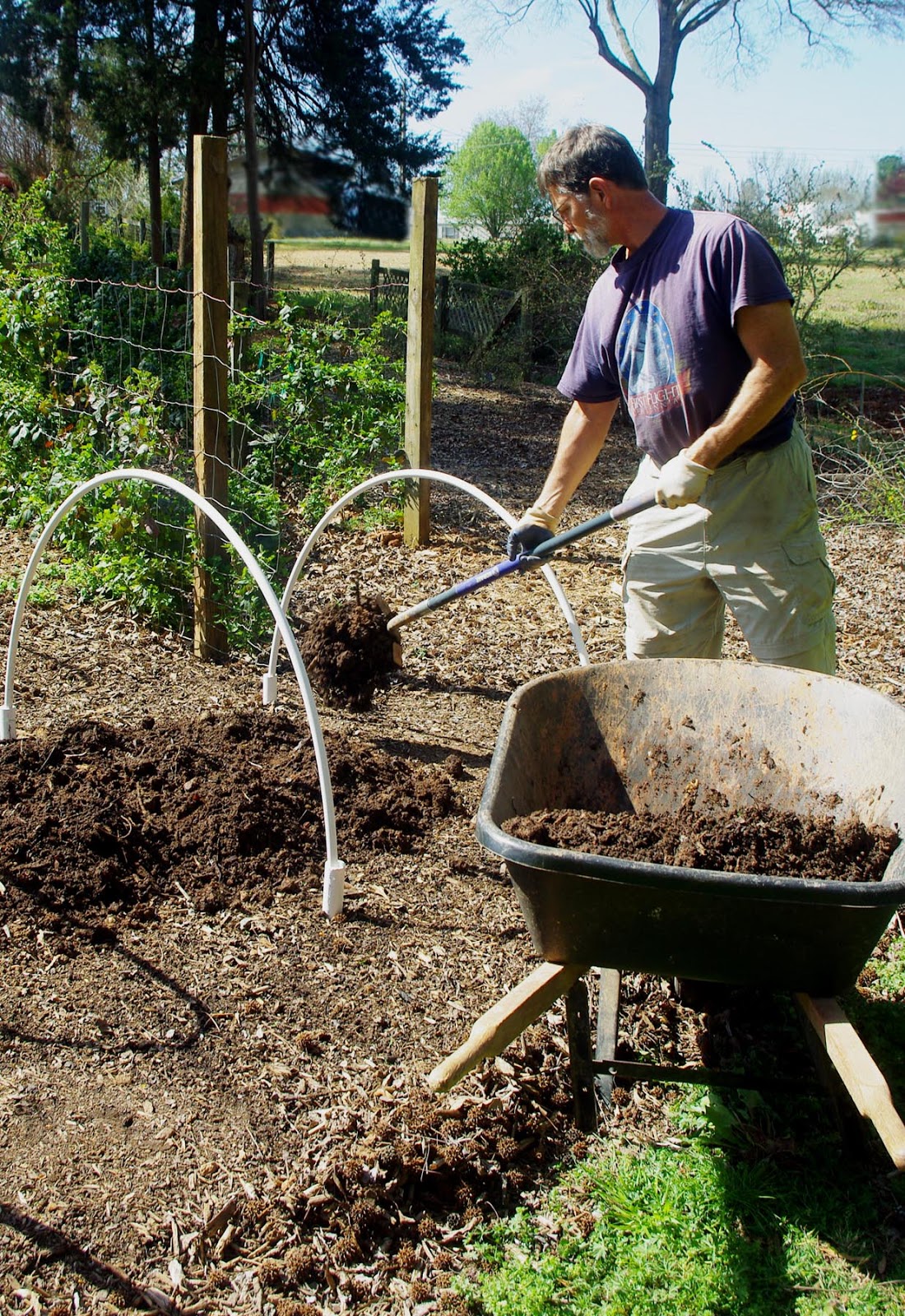
Da is top dressing the beds with compost before I plant the next round of veggies.

The compost is very friable and full of earthworms.

While Da is top dressing, I am clearing the cabbages from the bed and preparing them to go inside to become sauerkraut, dehydrated cabbage and stir fry for dinner.

Cabbage heads and trimmings. The cabbage heads go to the house, trimmings go to the compost pile.

After the most of the cabbages are cleared from the bed I rake it clear of debris. Da will top dress once it is cleaned up and I will replant with the next crop of late spring cabbages.

My next task is to prepare the cabbages to become sauerkraut and dehydrated cabbage.

We will use the dehydrated cabbage in soups and casseroles. We eat mostly raw, but on occasion I like to have something cooked. The rest is stored for long term storage emergency pantry use.

By 2 o'clock the  green drink and mountain of fresh fruit we had for brekkers have disappeared and tummies are grumbling. It is time for me to make lunch! I will start with a base of fresh picked and washed mixed lettuces, chard and spinach from the garden.

To the bed of greens I will add grated organic carrots, bell pepper, red onion, broccoli, home made raw sauerkraut (see tutorial), home made raw daikon radish and carrot pickles (see tutorial), and top it with a few soaked raw cashews. There is no need for a salad dressing since the kraut and the pickled veggies add both a burst of flavor and a little moisture.

I topped the salad with a sprinkling of dulse flakes for extra vitamins and iodine and add a side dish of fresh mango, pineapple and kiwi. A healthy, tasty and beautiful lunch that is a feast for the eyes as well as the body!

 The rest of the afternoon was spent preparing dinner and working on this blog entry... I am beat. We got a bunch of things done, spent time in each others company and even got a start on a bit of a tan, it has been a lovely day!

Blog Hops this post is linked to:
Clever Chicks Blog hop #30


A Long Time In Coming... Part 2

In the intervening years since the chimney fire, (read part one of the story here), our little cottage has seen many changes and improvements. The initial construction was done when we were novice builders and there were some things we decided to do over, due to mistakes made by inexperience. We also had to use salvage goods for building materials, since there were limited supplies for a good while after the hurricane, so we replaced our salvage yard doors and floor coverings as time and money allowed.

The total time elapsed on completion of the house after the hurricane was about 6 years. During those years we lived our lives around the construction projects going on inside. We split our time between indoor construction projects, and establishing gardens and outbuildings to house our growing menagerie of barnyard animals.
A roof top view of one of our early garden configurations. The espaliered fruit trees and our two "sentinal" plum trees were just a few years old. The potting shed was later torn down to make more room for blueberry bushes.

The kids helped to finish their rooms, doing whatever task was appropriate to their age. Driving nails, spackling sheet rock, sanding and painting, were some of the things that they did. Our oldest son, who was 9 or 10 at the time, wanted to place a time capsule in the space above his door frame, so in the future if the walls ever came down again, there would be a history of the boy whose room it was. Before we closed the walls in with sheet rock, he placed his time capsule in the wall and signed the wooden header above the door with his signature and the date. The youngest also "signed" his wall frame before the sheet rock went up, although his signature was that of a 3 year old so it wasn't really legible. I think the experience of living as we had to live for those years, gave my children exposure to a number of useful skills and experiences that added significantly to their lives as adults.

Our house has been a work in process for 24 years, we have raised our children, home schooled two very different children, supporting their interests by allowing them to develop parts of the yard for their own use. N. our oldest, was very interested in creating bonsai. He had several beautiful specimens that he created and more that he collected from other places. He selected the east side of the house to have a showcase garden for his bonsai. He and his dad designed and built display tables for his bonsai and collection of Ping Mountain rocks that he used as foils for his trees. It was a lovely addition to the yard and gave us much pleasure.
Our oldest son with a couple of his bonsai trees. Circa 1996
N. training his root over rock Ficus Benjamina


 Our youngest child, E.M., was interested in animals and wanted to raise chickens. He and his dad built his first chicken coop when he was 6 years old. His first flock was a bantam rooster and  5 hens. As the years went by we added other chicken coops, then we added a rabbit house and later two barns for our herd of dairy goats and their progeny. He raised chickens and sold eggs and supplied eggs to our table,  sold rabbits to 4-H members as show animals, and the dairy goats gave us an ample supply of goats milk for cheese and to drink.  The grounds around our house were developed to support his interests and we enjoyed the life that the animals brought to the homestead and the wholesome, beautiful food that came to the table.

The first small coop that 6 year old E.M and his dad built to house his prized bantam Rooster "Bad Boy" and his 5 hens. The bantam eggs make wonderful omelets!

E.M. planting flowers around the rabbit cage in his "Bunny Garden"  Circa 1996

 Our home schooling years, (17 years in total), occupied our attentions and land for many years. As the boys grew and developed new interests, we tried to make sure that they had a place and time to explore them. Now that the boys have grown to men and live in their own places, the homestead has been taking on a new face. We are now crafting our land to meet the needs and interests of an empty nest couple. Our interest has always been self sufficiency, organic sustainable agriculture, and preserving of "lost arts" like herbal medicine, food preservation, and "simple" living. Now that it is just the two of us, that is our focus. We are vegan, so we no longer need to have livestock or chickens, and as much as I loved having the animals around, I want to be free to travel for extended periods, so we no longer have barnyard animals. We have been streamlining our gardens, adding more beds to host my medicinal herbs and beds for permanent perennials like asparagus and ginger and edible perennials that we never had room for when we had growing boys, (and their friends), to feed. We have also been looking to the future with our efforts going to establishing a learning center/ nursery here at Heart's Ease Cottage. Teaching is my passion, and I want to make our years of experience and the techniques that we have developed available to others who are interested in self sufficiency and small scale homesteading. More on that in future blog posts, but for today I want to turn one of our most recent projects...

A year or so ago, a friend of ours gave us a 1890's vintage wood stove. He had kept it as a project for years, but never had the time to work on it, so he gave it to us. It spent a year in stasis in one of the chicken houses, protected from the weather, but still in need of a lot of TLC. Then last summer, my husband began to putter on it, brushing it with a wire brush and sand paper to eliminate the rust, (much of this was done without my knowledge, since he was trying to surprise me with the completed stove).

One piece of the unfinished stove

He sent several of the ornamental parts off to be nickel plated, and began to make plans for the interior brick chimney to be refaced. At this point he let me in on the surprise, since he knew I would want to choose the new interior look. We had the chimney repaired, the interior refaced and the stove sanded  and painted with stove black. When the decorative pieces arrived, (a saga in itself, where the plating company changed location and lost some of the key parts... which as of yet have not been found or replaced...sigh.), we were ready to put the stove in place and hook it up to the new chimney. So, after 22 years of waiting, Heart's Ease Cottage is once again equipped with a wood burning heat stove. The project is not finished, since we will be refurbishing the wood floor in that room during the warm weather months and installing a ceramic tile base for the stove to stand on. For now the stove is sitting on a fireproof pad awaiting the completion of that room. But in the meantime are able to use the stove and enjoy its warmth for heat and ambiance.It has been a long time in coming, but it is so worth the wait! Many thanks and big hugs to my husband for knowing the desires of my heart and working so hard to bring them to life!

The old Franklin stove and the 1944 brick chimney which was damaged by the hurricane.  Circa 1989


A day time view of the new stone and newly refinished 1890's stove.

 I am so excited about having a working stove in that room again, and it sure is pretty set against the lighter stone we chose for the chimney face!  Circa 2013

So while the cool weather lasts, we are drinking hot tea and playing cards or backgammon near the fire and enjoying the fruits of our labors. Until next time! I hope you are loving life and living your dreams!

Blog Hops this post is linked to:
Busy Bee's Blog Hop #12 
Country Homemaker Hop#60

05 March 2013

Daring to Dream

 I was reading blog entries on my blog feed recently, when I ran across  this blog post by Rachael at  thealisokitchen.com. It made me think back to the days when I was just starting out on my adult life and dreaming about what I wanted my future to hold. I was working as a hairdresser in Blacksburg, Virginia where my family landed after my dad retired from the military. I was 20, living on my own, working hard and dreaming of the day when I could have my own little piece of the Appalachian Mountains, where I could live a simple life, bake bread, raise animals and grow my own food. At that moment in my life I was very far from attaining my dreams, since I lived alone in a tiny little trailer in a college town trailer park, worked 12 hours a day standing on a cement floor, cutting hair, and had little practical experience in doing any of the things I was dreaming my future would hold... but living with your dreams for awhile before you try to make them come true is not a bad thing.. time and experience will help to clarify what you really want. There were many lessons I needed learn while I was waiting to find the piece of land and make my dreams come true.

While I was working, saving and dreaming, something happened to change the course of my life... I found my soul mate. My dreams needed to be blended in with his dreams, to become "our" dreams... We met in the late 70's during a terrible recession, and jobs were not easy come by, so we both joined the military. Since traveling the world was something we both had on our Bucket List, this was a way for us to get started. We lived in the Philippines for 3 years and it was during this time that we would learn many of the life lessons that we would need for our big dream to come true. Living in a third world country taught us much about living a simple life. It changed us, and matured our dreams, it also gave us time to equip ourselves with the skills necessary to make our dream of self sufficiency a reality. We studied and practiced on a small scale, growing plants in pots on our stoop, or in an on base community garden plot, reading everything that the base library had on organic gardening, and animal husbandry. I improved my baking skills, and learned to cook meals over a 8" charcoal burner. I watched our Philipino friends as they lived out their simple, self sufficient lives and tried to take back with me the valuable lessons I learned from them.
Bath Time! Merlyn my close friend and I bathing my son. Philippines Circa 1982.

    Our three years in the Philippines were well spent and upon our return to the states we tried to go back to the mountains of Virginia to apply what we had learned, but that wasn't to be... there was no work to be had in the area where we wanted to live, so we had to look elsewhere. My husband was offered a job in Charlotte, NC and we bought a little house in a residential area in the city. One of the first things we did when we had settled into the house, was to start veggies from seed in a sunny window and dig up the front flower bed and plant zucchini, tomatoes, herbs and flowers.
Spring garden planted in the front flower bed. Circa 1984
Zucchini and pink petunias, front flower bed. Petunias are supposed to deter squash bugs... it seemed to work, we had no bug problems at all. Circa 1984
 Over the course of the 5 years we lived in that house, we terraced our steep back yard into 3 levels, formed up raised vegetable beds, built a 3 bin composting system and rabbit cages, laid brick paths and created a permanent herb garden on one side of the house.
Growing our food in a terraced garden on our steeply sloped back yard. The compost bins and rabbit cages are on the flood plane below the garden. Photo circa 1986
My husband laying a brick path through the herb garden with recycled bricks.

  We put our newly learned skills to good use in the yard and the house and the gardens were much improved by our efforts, but it was time to move on. My brother was living in a small community 35 miles south of Charlotte. So we found a little fixer-upper cottage on an acre of land and moved to Waxhaw to be closer to my brother, who was terminally ill. By then, we had two boys, one who was 7 and an infant of 4 months. We were planning on adding on to the house, living in the old part while building the new addition. All was going as planned and the addition was "dried in", (which means it was under a roof and protected from the elements), or so we thought... Then 18 days later Hurricane Hugo blew in and destroyed all of our hard work. We spent the next several years trying to get back on our feet.Our recovery took time, but we kept plugging away. Our boys grew and the house was eventually finished.
   During all that time we worked very hard to establish the "bones" of our gardens and enrich and amend the soil. We sowed and harvested, built outbuildings and barns to house our goats, chickens and rabbits, and planted fruit trees, berry bushes and strawberries. Somewhere along the way we realized that we were not going to have a homestead in the mountains, instead we already had a homestead in the Piedmont!  Our dream of having a homestead and living a "self-sufficient" lifestyle had come true, but it happened over time and progressed naturally, developing and changing with the needs and interests of our family.
When the kids were too old for their playport, we turned it into a goat barn. Circa 2006


Mouse and Sweet two of our young dairy herd. Circa 2006

My youngest working on the second barn. Circa 2007


E.M. milking "Jelly" on a stanchion that he designed and built himself. Circa 2007
Sisters Izzy and Sunny having breakfast. Circa 2007
E.M. with the girls... he was happiest when he was outside working in the gardens or hanging with his animals. Circa 2006

Comice pears. The pear trees and our apple trees are trained as espaliered trees to most efficiently use our limited space.
This plum tree was one of two standard sized "sentinels" that stood at the opening to our vegetable garden. Both had to be cut down due to a freak accident while we were living in Costa Rica... I still grieve their passing.

   It is important to dare to dream, to follow your heart and live life with direction and purpose, but it is also important to realize that life is an organic process and there is only so much we can do to influence the outcome. We can work hard to shape our dreams into reality, but life will add its own twists and turns and in the end you may not end up where you expected... Our journey has been full of twists and turns and we have enough stories to fill several volumes. I may not have ended up where I hoped to, but I am delighted at the way things turned out!
This young pullet was one of 6o birds we kept in the Taj Mahal ( a three run multi-roomed hen house that my youngest son and husband built. It had three roomy hen rooms, three nice long runs and a "hospital" for birds that might need extra attention, there was also a foyer with a fridge for the eggs and equipment storage Sorry..we never took any good photos of the Taj)

Our youngest son had an egg selling business that he ran as part of his home schooling. He kept the books, managed the flocks, collected and prepared his eggs for sale and sold all the eggs the hens could lay. He did this from the time he was 6 until after he was out of high school. He had a waiting list of people who wanted to buy his eggs... so as a household, we ate the culls, those that were too small or too large, misshaped etc. since the rest of the eggs were claimed by his faithful customers.
We ground our own wheat and made six loaves at a time to feed the household. I still grind my wheat, but now that the boys aren't at home anymore I don't have to bake 6 loaves at a time!
Snap Dragons in the rose bed bloom cheerfully all summer long
    So, I've talked about my dreams... what about yours? Leave an comment. I would love to hear about what you are doing to make your dreams come true! Thanks for dropping by!

Blog Hops that this post is linked to:
Clever Chicks Blog Hop#24
Frugally Sustainable Sustainable Ways Blog Hop #66
Monday's Homestead Barn Hop #101 
Farmgirl Friday Blog Hop #99

07 February 2013

Growing Food in the Winter


Most years, we grow in our garden for three seasons and the take the coldest months off. But since we have been eating vegan and juicing regularly, we have gone to gardening all four seasons. Organic produce is expensive anytime, but is particularly so in the winter when everything is imported from warmer climes. So we have cut our grocery costs substantially by growing our own leafy greens ad root crops.

We live in the Piedmont of North Carolina. Our winters are mild in comparison to those who live in the north, but even in the north, with a little inexpensive shelter, some produce may be grown to keep fresh stuff on the table and to help with grocery bills. Even here in the south, our temperatures get down into the teens at times during the winter, so we have to chose what we grow in the winter months carefully.
There are may heirloom and open pollinated varieties of vegetables that can be grow in the winter. At the moment, I have these growing in my garden: Blue Scotch Kale, Mixed Wild Kale, Bloomsdale Long Standing Spinach, Tatsoi, Bok Choi, Turnips, Lollo Rosso, Black Seeded Simpson and Cos Romaine Lettuces, Escarole, Russia Red Mustard, Bright Lights Swiss Chard,Jersey Wakefield Cabbage and Fava Beans. All but the lettuces are just planted out in the garden. The lettuces are under a green house tunnel to give them a little extra protection and solar heat. All of these vegetables will withstand cold temps., frost and intermittent freezes, as a matter of fact the kale is sweeter with a frost or two under its belt!. A few nights ago, it was 19 degrees over night with a heavy frost in the early hours. The plants were all covered with frost, and were frozen solid. When I went to pick some kale for my morning green drink, and the kale I snipped shattered in my hand since it was frozen. But when the sun came up and the temps. rose above freezing the plants were all fine. Some of the older leaves on the turnips and swiss chard looked a little wilted, but that was the worst of it.

Kale is frozen solid and frosted over, but is sweeter after a frost or two


This bed has Blue Scotch kale, Wild Mix kale, Tatsoi Oriental greens,and  Bloomsdale spinach


A bed of Jersey Wakefield Cabbages are almost ready to be made into sauerkraut

a greenhouse tunnel made from PVC pipe and 6 mil plastic gives Lollo Rosso, Cos Romaine and Black seeded Simpson lettuces some protection from the harshest weather and raises the temp enough to insure good growth.

It is possible to grow winter crops out of doors even if you don't have room for a garden in your yard, or if you live in an apartment and have no ground at all. Many winter veggies will grow quite happily in containers on sunny porch, deck, balcony or tucked up against a south or west facing foundation wall. They are easy to grow, have no pests in the winter and require only a minimal amount of care. Lettuce and other greens have shallow roots can be grown in flower boxes, or even re purposed rain gutters. Deeper rooted plants like  as well as beets, carrots, turnips, cabbage and brussel sprouts will grow beautifully in two gallon buckets with holes drilled in the bottom for drainage. I like to plant cabbages and pansies together in oak tubs as a practical, eatable yard ornament.

Beyond growing winter vegetable outside, there are a wide variety of nutritious, tasty, easy ways to grow food on your kitchen counter. Many bean and vegetable seeds can be sprouted in jars and consumed in salads and on sandwiches, as well as added to things like sushi, fresh spring rolls and as topping for tacos. I keep a steady supply going of clover, radish, broccoli, mung and lentil sprouts; which add interest, taste and texture to many of the foods we eat every day. Sprouts are a powerhouse of nutrition, take less than a square foot of counter space, and very little effort to grow.

Left: Mixed salad sprouts with anasazi, garbanzo and mung beans, Middle: mung beans Right: clover seed


Each item that you grow at home is an item that doesn't have to be bought at a premium at the grocery store. For example, yesterday I went out to the garden and picked a basketful of curly kale, I pinched a handful of parsley, harvested two turnips and cut the a third of the greens tops off a few of my fall planted onions. I used the parsley and onion tops in tabbouleh for noshing on this week, I made a dressed kale, turnip and grapefruit salad for lunch, and for dinner I used the last of my sweet potatoes, turnip greens and the rest of the turnip root that wasn't used in the lunch salad, to make a delicious plate of lightly steamed turnips and greens topped with sweet potato hummus and pistachios.


Kale, Turnip and Grapefruit Salad with Miso Dressing and Steamed Turnip greens with Sweet Potato Hummus

 If I had gone to the store rather than the garden to get my produce, I would have paid $1.50 for a bunch of parsley, 99 cents for a bundle of green onions, $3.99 for a bundle of commercially grown kale, at least 3.99 for the turnips, and another $2-3 for the turnip greens, (which are sold separately from the turnips), $2.50 for sprouts to top the tabbouleh. By picking a few things out of my garden and building meals around them I saved my grocery budget more than $15.97 for one day's meals,   ( I didn't price out the sweet potatoes, since I have no idea what they sell for so the savings was more than what I calculated). If I had quoted the price for organic produce, the savings would have been higher. If I go one step further than that and guesstimate that I use on the conservative side, $10 a day from my garden, then in a month I would have saved $300 dollars by growing my own produce this winter. Actually, the savings would be higher, since we juice at least six bunches of greens, (a mixture of kale, spinach, oriental veggies, and chard or beet tops), every week in addition to our regular meals.

It is well worth the time and effort in dollars and cents to grow your own produce, even in the winter. But the biggest reason for doing so is that you have the freshest, purest,most nutritious and the tastiest food possible to feed those who gather around your table.

                              Kale, Turnip and Grapefruit Salad
                                          with Miso Dressing
For Salad
1 bunch Curly Kale, washed well and spun dry
2 medium sized turnips
1 ruby red grapefruit, section and reserve juice, (be sure to squeeze all the juice out of the membranes after sectioning)
1/2 red onion
1 handful of Craisins
pinch of nigella seed or black sesame seed
For Dressing
Reserved Grapefruit juice
Enough  Braggs Apple Cider Vinegar to bring grapefruit juice up to 1/3 cup
1/3 extra virgin cold pressed olive oil
2 Tbsp. uma plum vinegar (or substitute with balsamic vinegar)
1/4 tsp. sesame oil
1 Tbsp. hemp seed ( if you don't have it on hand it is OK without it, the dressing will just not be quite as creamy)
1 Tbsp. white miso (or barley miso if you prefer it to be richer)
1-2 cloves garlic, (depending on how much you like garlic)
1 Tbsp. honey or agave

Place all ingredients in personal rocket blender, (or in regular blender if you don't have a personal blender), blend until smooth and creamy. Taste and adjust oil/acid balance, by adding a little more oil or more acid depending on what you think it needs. Only1/3 cup of this dressing is needed to for kale salad, but it keep a very long time in the fridge and can be used on regular salads or just kept on hand for the kale salad if you end up making it more than once. This salad dressing or a variation there of, is what we normally use on our dinner salads. It is full flavored, with a nice tang. You won't need to use much since it has a lot of flavor and sticks well to greens, so the dressing doesn't end up in the bottom of the bowl.

Cut the kale into thin strips. Slice the red onion thinly and toss with kale to distribute. With a latex gloved hand, gently "massage" 1/4 to 1/3 cup of dressing little at a time into kale and onions, to distribute the dressing. Only add enough to coat the leaves. Thinly slice the turnip, with a mandolin, ( if you don't have a mandolin then shave thin slices off with a vegetable peeler). Add turnip slices and grapefruit sections and toss gently with tongs to distribute. Sprinkle the top of the salad with Craisins and nigella or black sesame seed, (nigella seed can be found in an Indian grocer and it well worth looking for, the oniony peppery flavor really adds a lot to salads. If you can't find the nigella, the black sesame will do...or if you can't find either, the salad will still be good without it). Serve chilled.


 *Elliot Coleman, a four season, sustainable ag farmer, lives in Maine. He and his wife grow fresh produce for sale to restaurants in the dead of winter in Maine. He has written several very good books on the subject of four season gardening, at least one of which focuses on growing food in the winter. If you are interested in hearing more about how he does it, check out his website http://www.fourseasonfarm.com/.


The Self Sufficient HomeAcre
Blog Hops that this post is linked to: http://www.the-chicken-chick.com/ , http://frugallysustainable.com/
h,http://thismindbeinyou.blogspot.com/ , http://www.theselfsufficienthomeacre.com, http://deborahjeansdandelionhouse.blogspot.com/2013/02/farmgirl-friday-blog-hop-95.html, 
http://sustainablesuburbia.net/sustainable-living-blogs/


Related Posts Plugin for WordPress, Blogger...